Broad History only exists thanks to the support of members, who already know what I'm about to tell you. Thank you and welcome to new joiners Janet, Devin, Kate, Mary, George and Margaret, as well as to donors Kate and Lauren. 🫶
Join them! Members now get:
- early and ad-free access to the podcast
- new series in binge mode on day 1
- full access to the weekly newsletter
- exclusive historian interviews
- insider access to the making of Broad History
After spending a summer with the American revolution, we will together be spending the autumn on... the witch hunts.
It's a cliché, but the witch hunts were my entry into women's history. My mother gave me Mona Chollet's best-seller "In Defence of Witches" at Christmas 2022 and I was hooked. It had more than a bit to do with my decision to go for a master's in public history in 2023, and my first essay for that degree was a look at the Witches of Scotland project (public historians and podcasters themselves whom I'm hoping I'll have on the show).
The uncomfortable truth, however, is that the more I unpack what I read from Chollet – and the broader feminist pop history movement which has reclaimed the figure of the witch as an icon – the more I'm forced to admit that it's... not quite right. More precisely: It spins a political yarn around kernels of historical truths. Some of it has long been debunked by more recent scholarship; some of it was never that interested in academic research in the first place. (Some of it does hold up.) That's because it's a wholly different project – a useful one and one I do not reject, but one that places other values ahead of a discipline of truth. I – and I know it's unfashionable in 2026 – have always preferred a messy true story over a convenient elliptical one.
Of course, the second you try to insert nuance into that story, some will use it as a opportunity to do an 180° in the opposite direction. They'll point to the one country where more men were accused to immediately deny the misogynistic and patriarchal nature of the witch hunts, minimise their violence or refute that they belong specifically to women's history. We're not doing that.
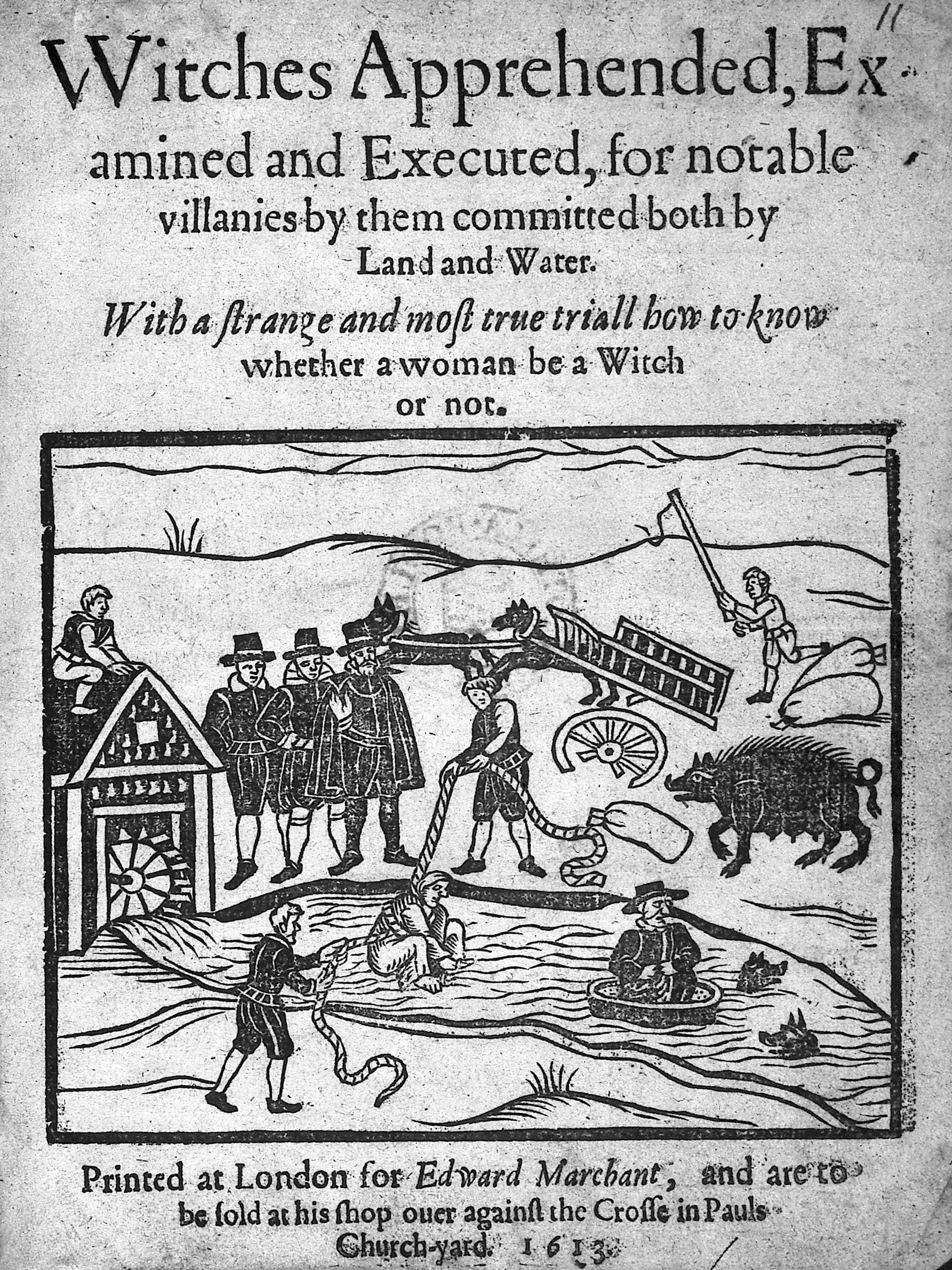
There's so much more here to unpack than I can put in a short email, but I wanted to let you know where I'm coming from with this. This is going to take a while to research and understand, but I'm taking you with me on this journey!
Here's how this is going to work
Over the coming season, I am going to be reading and interviewing many historians of the witch hunts to understand what happened exactly. I know so many of you are American, and we will certainly be looking at Salem and other colonial context, but we'll start in Europe. Between the 15th and 18th century, an estimated 50,000 to 80,000 people were killed as witches here; around 75-80% of them were women.
That alone raises so many questions for me. Why did this ideology that seems so "medieval" to us actually flourish just as modernity was coming into its own? What were the foundational texts and figures that spread these ideas and how did the violence become globalised? Did anyone dare to oppose it? Why were women especially, but not exclusively, targeted and what was the complicity of other women in accusing them? How did the Protestant reformation feed the witch hunts? What was the role of the centralised church and state versus localised conflicts and vigilantes? Why did early modern people so willingly accept even the possibility of witchcraft?
We'll try to separate the feminist icon of the witch from the ordinary women and men who got caught up in the violence. We'll pick at the common explanations surrounding the witch hunts – that women were targeted because of their financial or sexual independence, their knowledge of healthcare, their age, their spirituality ... – and learn which hold true and which can be discarded. We'll leave plenty of room for doubt because knowledge is never finite or final. We may even take detours beyond history through pagan religion, actual witchcraft practices or the cozy witch aesthetic (I'm a sucker for it, I'll confess) to understand the cultural power of it all. We'll kill a few of my own darlings, I'm sure, and we'll do it all together.
At the end of this whole process, which I'll document week by week on this newsletter, we'll have a brand new series of the podcast. This should keep us occupied until Christmas. I'm aiming to make a scripted narrative series this time, with expert interviews woven in, documentary-style. It's more work, but ultimately makes for a clearer and less repetitive series, and it will stretch my creativity in a way I relish. Producing in public is the solution I found in order to give myself the appropriate time to create a high-quality show requiring 100+ hours of research – without leaving you in silence for weeks on end.
Members will get privileged access to this new series
Producing in public is something I'm doing for all, and the podcast will always be free to listen to. But it's only fair that the folks who financially support Broad History – fewer than 100 people picking up the software and hosting tab for thousands of listeners – get a bit more bang for their buck. They also support me in devoting more time to BH (for now, I'm doing this 1-2 days a week), for which I am beyond grateful. (For the rest of my time and income, I've just become the publisher of investigative newsletter Democracy for Sale and I'm super lucky that that's an absolute blast too. Subscribe!)
From now on, members will get:
- all episodes of the Witch Hunt series early and ad-free – they'll be able to binge everything on day 1 (public release will be fortnightly)
- the weekly newsletter in full – there'll be plenty to feast on for all but some stories will be paywalled
- exclusive historian interviews – if you enjoyed the expert interview format of the previous series, fear not. I'll only use excerpts of the interviews in the series, but I will publish them in full on the members' feed for those who want to dig deeper
- priority access to get their questions answered and featured on the show
The other perk of producing in public is that your insights can feed the work! Many of you have dropped valuable knowledge or questions that stumped me in my comments or inbox in the past, but when they come after the episode is made, I can't do much with them. Now I get to incorporate all of that in the show. So tell me...
What do you want to know about the witch hunts? What have you read, seen or heard that I should be looking at?
PS: If you enjoy the idea of producing in public, do hit that follow button on Instagram. I post behind-the-scenes videos there that don't quite work on email so the two will be complementary. I also recently posted a round-up in numbers of the American revolution series. Thank you all for making it such a success! I can't wait to explore the witch hunts with you.