When I pick a topic for the podcast, I have more questions than answers about it. That's the point. The show is my excuse to find out, a cognitive device to force my Instagram-addled brain to drop the phone and pick up the books. It's the part of the job you don't see – or at least didn't until I decided to make this a process newsletter – and I love it.
Since I promised you a series in November, I've been hitting the stacks. One of you on TikTok (and it's lucky I saw it because I'm really only ever on Instagram) asked me for my recommendations.
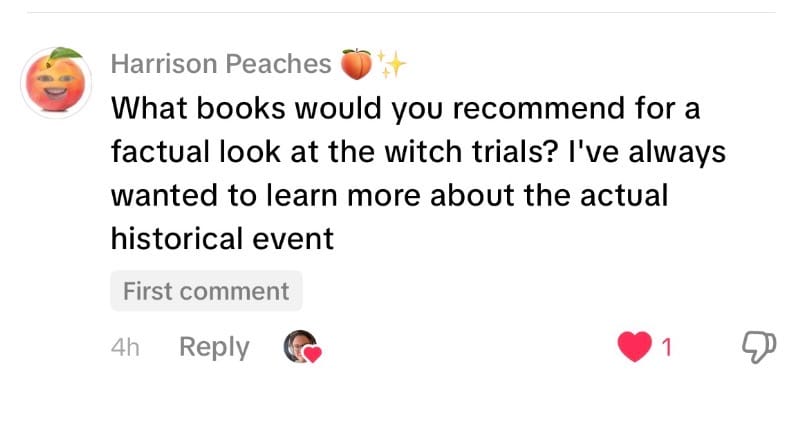
I love the question and it's not an easy one: Even in my serious-as-they-come academic library, histories of the early modern witch hunts are commonly mixed in with books about actual witchcraft or esoterica and political essays that use an approximative history of the witch hunts as a backdrop to contemporary convictions. It takes serious intellectual discipline not to mix them up. While I'm still reading and I haven't got my final list of recommendations yet, I can share the criteria I use in evaluating what I find in the stacks. Here are four things I quickly check before deciding whether to invest my time with a book.
- Is this book trying to convince me of something?
There are fundamentally two kinds of books about the witch hunts: factual histories that stick to the past and are merely a (re)telling of what happened, and contemporary interpretations that constantly jump between past and present to make a political point. You can usually identify the latter if not by their title, then by their opinionated subhead: "Why women are still on trial" (Mona Chollet's In Defence of Witches), "The demonisation of middle-aged women" (Victoria Smith's Hags) or "In Search of our Lost Feminine Power" (Susanne Tonti's Good Witch). These are not necessarily bad books, but they more commonly fall into the trap of cherry-picking facts that back their thesis. Proceed with caution. I would start with more straightforward histories to be armed with sufficient facts to read this second category with the required critical distance.
- Who wrote this?
When in doubt, turn to an academic historian. These people have painstakingly trained to question everything, to write only what they can prove, and to cite every line to within an inch of its life. They've often studied a topic for a decade or more before writing the book in front of you. The best of them manage to write general audience books that do not sacrifice storytelling to accuracy. I'd start with Marion Gibson, Malcolm Gaskill or Ronald Hutton. That said, there is also a long tradition of journalists, teachers and dedicated amateurs turned public historians who hold themselves to similarly stringent standards, even without a PhD. (Hello, it's me.) On the witch hunts, try Stacy Schiff, Daniel A. Gagnon, Claire Mitchell and Zoe Venditozzi.
- Does this author earn my trust?
Now open the book. Read a few pages at random and pay attention: Is the tone peremptory and unquestioning or does it allow for nuance and doubt? Are ideas stated or are they demonstrated? Does the author acknowledge arguments that run counter to theirs? Look for footnotes, citations and a solid bibliography. See if they occasionally use the phrase "we don't know" or debunk a convenient belief. Bonus points for uses of primary documents. This kind of work is more trustworthy and it spares the writer ending up with egg on their face when, inevitably, they are proven wrong. See below.
Broad History is only possible thanks to members who chip in to buy me time (and software) to make it. They'll get to binge the show the second it's ready. Thanks to all and welcome to new members Cheryl, Heather, Haley and Racheal. Join them!
- When was this published?
History is not fixed. It's a constant work of reappraisal and rediscovery. The older the book, the more likely it is that it has been at least partially invalidated or improved upon by later scholarship. Frustratingly, Silvia Federici's "Caliban and the Witch" (published 2004, but adapted from essays from the 1980s) or Barbara Ehrenreich's "Witches, Midwives and Nurses" (published 1973) are still widely and unquestioningly cited in pop histories of the witch hunts, even though historians have now largely disproven their central theses. (These books also belong more to the political category in the first place. We'll get into this in the show and a future newsletter.) Even when the book is just a few years old, it's worth a quick Google – or gold standard, if you can access them at a good library, a search through scholarly journals – to see what objections have been raised.
We should all read and write humbly.
That books once foundational to women's history are now quite outdated should be a lesson in humility to all of us, readers and writers alike. Read widely. Hold on loosely. Never trust a single source – not even me.
With all that in mind, here are some books about the witch hunts I'm enjoying and that seem solid so far. (Here is the same list for UK readers.)
Your recommendations
You all really showed up after last week's newsletter announcement of the new series. I love it! You privately sent me your own recommendations for documentaries, courses, guests to book... I thought the whole group should benefit.
- Broad History member and friend Jackie is a fan of medieval historian and fellow podcaster Eleanor Janega, who once taught her a whole day class on the Malleus Maleficarum, the foundational text of witch-hunting. We'll certainly explore that, maybe even with Eleanor, but if you wanna do some advanced learning, here she is talking about the Malleus Maleficarum on an episode of Betwixt the Sheets with Broad History past guest Kate Lister.
- Mark recommends this short online course on Witches, Werewolves and Magic in European History and the fantastic podcast Witch from BBC Radio 4 which I'm jealous I didn't get to make.
- For the Brits, Tracy recommends this episode on the witch hunts with famed TV historian Lucy Worsley, available on iPlayer. Another primer, looking exclusively at Scotland, which had some of the worst witch hunts.
- On Instagram, lady.mommyington (a frequent commenter, hi!) also recommends How to Kill a Witch by Claire Mitchell and Zoe Venditozzi. The book came out of their long-running podcast and public history project Witches of Scotland. The two women (a lawyer and a writer) secured an official apology from the first minister of Scotland for the harm done by the state. I definitely will be asking them onto the show. Stay tuned...