I recommend clicking through to the web for readability and an audio version of this long read. This all started with a simple question I asked myself in my Early Modern London class...
Where did the nuns go when Henry VIII closed all religious houses circa 1539? This may feel like a niche question, but think about it: Here you have in a few short years the complete destruction of an entire industry, tens of thousands of people having to reinvent their way of life, and an unprecedented transfer of wealth to powerful plutocrats. Plus, because Henry loved his paperwork, we have reams of data about it and a unique opportunity to compare the fate of men and women under the exact same circumstances.
The event has come to be known as “the Dissolution of Monasteries,” but the moniker helps us ignore half the story – it was a dissolution of monasteries and nunneries. Actually, 20% of the story: female institutions were a minority and there were only an estimated 1,900 nuns in England at the time. That makes them much easier to follow in the archives. What I found is that the dissolution dealt a much heavier blow on religious women than on their male peers, but most interesting of all is that it wasn’t because of blatant gender discrimination. Even five centuries ago, it was subtle, structural inequities in a nominally fair system that guaranteed women worse outcomes. Sounds familiar?
Dissolution 101
Refresher: Henry wanted to marry Anne Boleyn but was already married to Catherine of Aragon. When the pope wouldn't grant him a divorce, he decided to break with Rome, create his own church and grant himself the divorce. One key element of the creation of the Church of England was the suppression of all monastic life; religious institutions were seen as corrupt and too loyal to Rome.
Dissolution didn't happen all at once. From 1535, men and women under 24 were excused from their vows, given secular clothes and told to go home. Henry – in practice, his favourite bureaucrat Thomas Cromwell – then disbanded the “lesser” houses with income under £200 a year, which took care of most countryside nunneries. Before long, in 1538, it was the turn of “greater” houses such as those in the capital, which drew a healthy income from vast urban property holdings. By 1540, there wasn't a monastery, convent, friary or priory left in England.
Henry redistributed their lands, buildings and goods to the Crown and his favourite aristocrats. It was the biggest transfer of wealth in British history, on par with the portioning of former communist countries among oligarchs in the early 1990s. What happened to the monks and nuns? They were mostly shown the door and told to get on with their lives. That's where paths diverged for men and women.
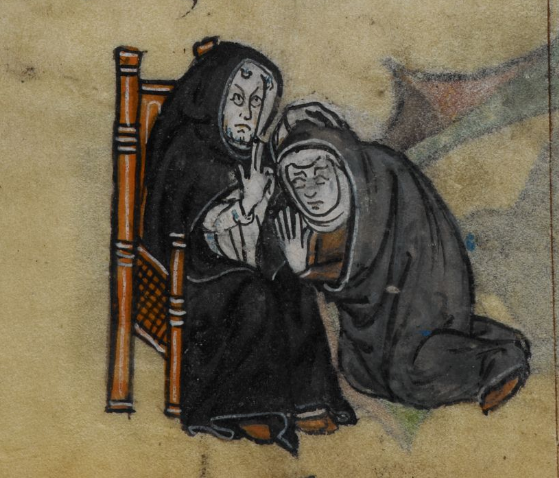
The (near) impossibility of marriage or work
The Reformation was a domestic conservative revolution. Breaking with the medieval glorification of chastity, the new mindset praised marriage as an ideal natural state and defended the political, economic and social interests of the married craftsman as the patriarchal head of his household. The Reformation plucked women out of the cloister and put them back at the centre of the family.
That was all well and good for the next generation, but not for those women pushed out of the nunneries. Henry VIII kept fairly Catholic views, among them the primacy of chastity vows, made to God, not to Rome. (Funny how that didn’t apply to his own marriage vows…) Any early confusion about the right to marry was dispelled with the passage of the Act of Six Articles in June 1539, which prohibited the marriage of former religious men and women on pain of death. Those who had married in the preceding, ambivalent months were quick to undo their unions, or at least publicly denounce them. The prohibition was only fully lifted with Elizabeth’s accession in 1559. By then, even those women who had been in their 20s at Dissolution 20 years earlier were long past marriageable age.
If not marriage, work then? Easy enough for former monks, who found positions as clergy in the Church of England or were welcomed in universities. But the new religion had no use for women whatsoever, however learned in the faith, until the first ordination of women priests in 1994. The few economic activities religious houses had supported – breweries, apothecaries, book copying and inluminating... – required tools and startup capital. Lay sisters may have continued their task in secularised hospitals or entered service elsewhere, but the middling sort and gentry women who were leaving the convent had no trade and little chance of employment outside kinship networks.
Pay on your way in, get paid on your way out
What was left was the prospect of surviving on a meagre pension. Former monks and nuns were entitled to lifelong payments to compensate for the total destruction of their livelihood. But the way they were calculated exacerbated structural inequities and kept many women in the most abject poverty.
By practice if not by canon law, women entered the convent with a dowry, just like they would a marriage. The religious life was not a refuge for empty-handed girls; it replicated the social hierarchies of wider society. In wills, you see fathers set aside sums for their daughters, to be used either for marriage or for a “profession fee.” The grander the family, the grander the house, and the grander the fee. It could be around £40 for a decent London position, completely outside the reach of most people, with further donations expected in order to go up in the ranks. Even less prestigious institutions expected novices to have some education, to at a minimum arrive with a trousseau and to provide for their own needs. Most convents therefore recruited from the parish gentry or among city merchants and craftsmen. Women who could not afford such a career became lay sisters. They took simple vows of humility and obedience and laboured in exchange for room and board. This ended up mattering greatly because the way you entered the convent determined how you left it.
Pensions were based on the individual’s age, years of profession or potential office, as well as their house's wealth. Their attribution seems to have been more concerned with maintaining the pre-existing social order than ensuring a dignified living for all. Hierarchy was paramount so that it wasn’t rare for the head of the house to receive considerably more than even the most senior nun. Elizabeth Salvage, prioress of the Minories in east London, was granted £40 a year, while her immediate deputies received 12 times less. Her lay sisters were simply dismissed – they hadn't bought their way in, they wouldn't be bought out. In the lesser houses, rank and file nuns weren't provisioned for at all; only heads of houses received an annuity. Sybil Kirke, the rather reviled prioress at Stratford-at-Bow, was granted £15 while her nuns complained of hunger.
What happened to "Julian Heron the idiot"?
Monasteries and convents sheltered and fed the most vulnerable – the intellectually or physically disabled, the very old, the very sick and the very poor. Their suppression left a massive gap in the social fabric. Here's an example from the Minories, a wealthy house of Poor Clares just outside London's eastern walls at Aldgate. Jane Gowryng, Frances Somer, Mary Pilbeam, and Barbara Larke, all nuns in their early 20s, and Bridget Stravye, a novice of just 15, are living there when the 1536 law forces them out for being under 24. They petition Thomas Cromwell to be able to stay. It seems they were heard because I found them again in the Dissolution rolls three years later. They also beg him to provide for their lay sisters, Margaret Fitzgared, 12 years old, deaf and mute, and Julian Heron, 13, an “idiot fool.” Surely, the king does not mean for them to fend for themselves. By 1539, Margaret is a professed nun of 16 and is pensioned. But Julian, the intellectually disabled teenager, appears alongside all the unpensioned lay sisters, such as Joan Crosby, 95 years old, or Elizabeth Martin, 68, with just two words: “all cancelled.” What happened to them?
The making of a pension gap
The historian Kathleen Cooke calculated that the median pension granted women was 4 marks or £2 13s 4d. The median male pension was nearly twice that at £5 10s. Were Dissolution-era nuns victims of what we’d today call gender pay discrimination?
Syon Abbey is an interesting case study to consider the discrepancy. The large Bridgettine house on the banks of the Thames in West London, was mixed, home to 52 nuns and 12 monks. It wasn't unheard of for larger institutions to house both sexes, but they were always under female leadership, and those women were handsomely rewarded – 300 marks to the abbess Agnes Jordan, the highest pension given to any woman in the country and higher than all but a few men. (A mark is two-thirds of a pound, or 13 shillings and 4 pence, a common accounting device in the early modern era that makes maths far easier in the non-decimal currency system.) The highest pensions at Syon went to women in leadership, and monks and nuns down the ladder were then treated equally according to their seniority. The four lay sisters and five lay brothers each received the exact same sum of 4 marks. In the medieval and early modern era, class is a much bigger differentiator than gender, and that's what we see across all mixed institutions.
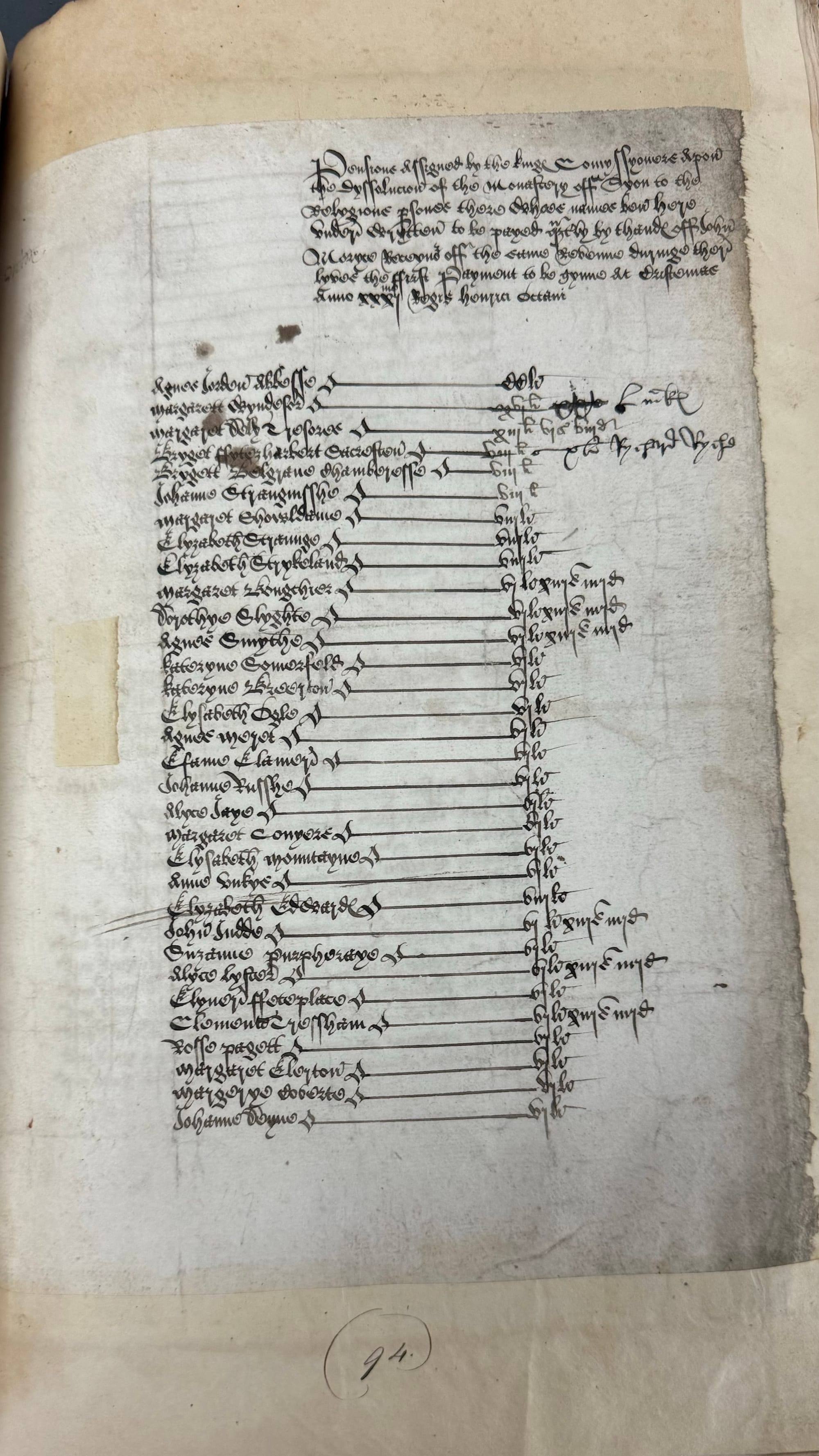
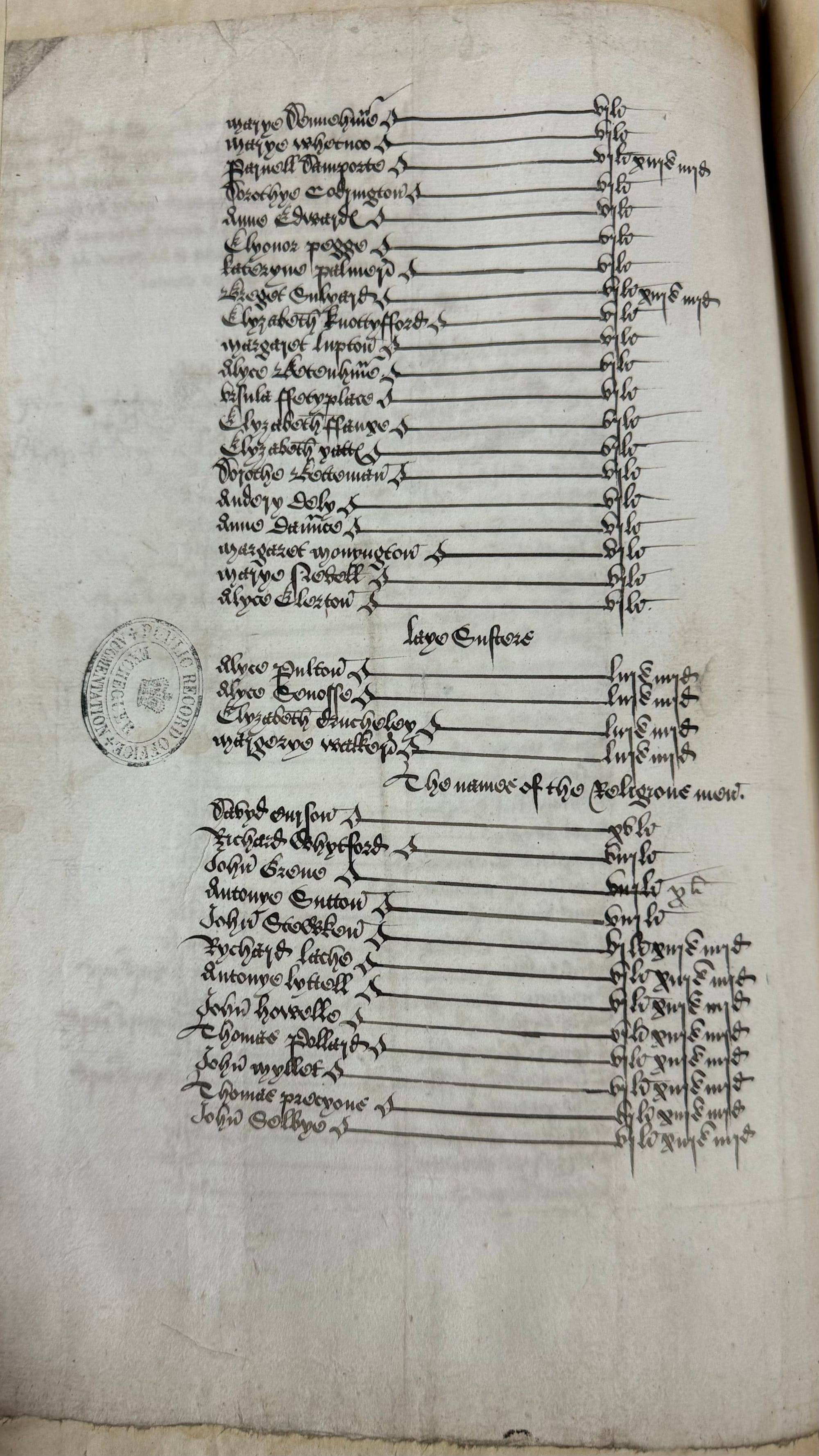
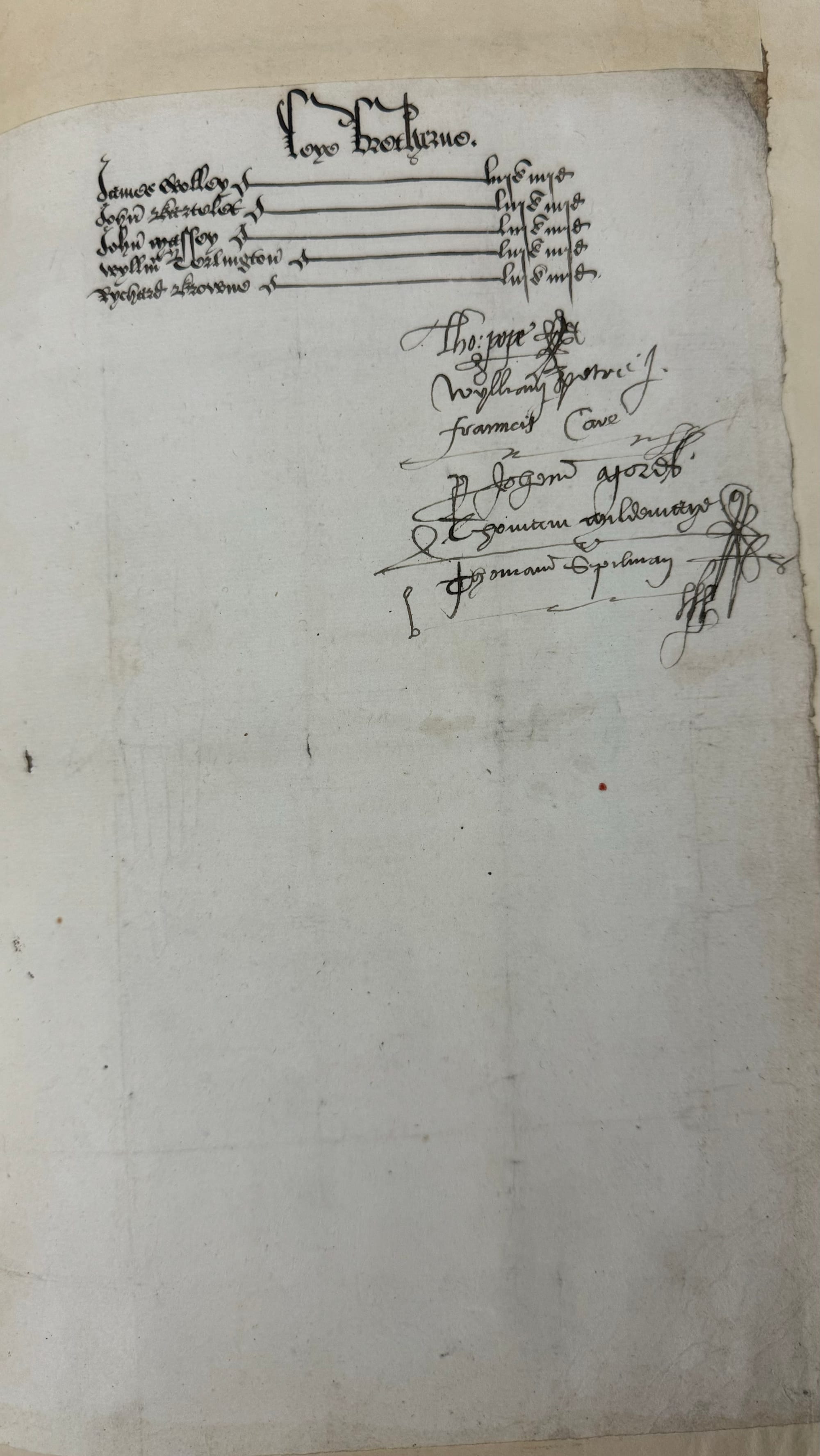
The warrant of pensions of Syon Abbey, a mixed house west of London. Yes, reading it takes some practice. Men and women appear to have been treated equally according to seniority, not gender. (National Archives, E315_245_94)
How do we know all this?
History loves a bureaucrat. The Dissolution was preceded by a vast nationwide survey of the more than 900 religious houses. The Valor Ecclesiasticus established the worth of each institution's property and income as well as who lived there. Research gold. What we know of the nuns’ fate, we then largely infer from the records of the Court of Augmentations, the administration charged with taking control of the religious houses’ finances and properties and assigning cash rewards and, vitally, pensions to the former religious men and women.
I also crunched the numbers to compare pensions at male and female houses of similar size and income. I'll spare you the maths and give you the conclusion: There is no evidence of wilful gender discrimination, only of subtle and relentless systemic inequities. Pensions were drawn not from some national, common pot, but from the estate of each organisation.
Two issues: First, nunneries were generally poorer. Nearly half of England's convents had income below £50, versus just about 1 in 7 monasteries. Wealth was built on centuries of donations and land grants from monarchs and wealthy patrons, and you can see how that would favour male institutions. In fact, nunneries were so poor that Cromwell reprieved nearly 50 of them in the first round of dissolution. If he had truly closed all 116 houses worth less than £200, as the law intended, he would have found himself with thousands of respectable women suddenly out on the street. That stayed the king's hand for at least a couple years.
When nuns of the dissolved houses were given the option to either leave religious life or transfer to another house, nearly 9 out of 10 opted to stay – many more than men. With little to no pension, without a trade, without the right to marry, or even to inherit, there just wasn’t much of a life awaiting them outside the convent and they knew it. Which leads us to the second issue: nunneries were crowded. Once they had absorbed the refugees pushed out of lesser houses, nunneries had to provide for them. A female house may have had as big a pension pot as the monastery down the road, but it was divided up among many more souls.
And that's how you end up with equal treatment on the surface, but inequity in the outcomes.
Could you live on £2.67 a year?
In the 1530s, an annual income of £5 was considered a poor living for a cleric. Life was more expensive in the capital too: in 1531 already, junior clerics complained angrily to the Bishop of London that a yearly wage of 10 marks (£6 13s 4d, or £6.67) was “but a bare living” given rising costs. The median pension given an English nun? 4 marks. What’s more, pensions were fixed and the 16th-century economy is known for inflation. By the mid-1540s, a lucky senior nun's pension of £6 was little more than a farm labourer’s wage. The last monastic pensions were collected around the turn of the 17th century, at which point their purchasing power had roughly been divided by three.
“Many a young nun proved an old beggar”
The life of a former nun was that of a dependent spinster. Those with the option moved in with a parent, a married sister or a friend. Once again, aristocratic women fared better – deprived of work and independence, but at least handsomely housed, ironically sometimes on the very land they had just left. It is not uncommon to see the same family names among the better-pensioned former heads of houses and the aristocrats who shared the spoils.
Parliament, apparently intent on making their lives difficult, barred former religious women and men from inheriting any part of an estate in order to protect existing heirs – who sat in Parliament. That’s why the wills of even loving parents only grant former nuns annuities, not property, and beseech siblings to take care of them. Women passed from the care of a father, to that of a stepmother or a brother-in-law, and eventually her parish when all who loved her had gone. Another coping strategy was for them to maintain a form of communal, and even quasi-monastic, living. Two or three former nuns sharing accommodation not far from their old convent helped reduce expenses and face a less jarring transition to secular life. There are hints of several such arrangements in the pension books, where individuals of the same communities can be seen collecting their due together, or on behalf of one another. Ties of friendship must have remained. Former nuns provided for their sisters in religion in their own wills and testaments decades after the Dissolution.
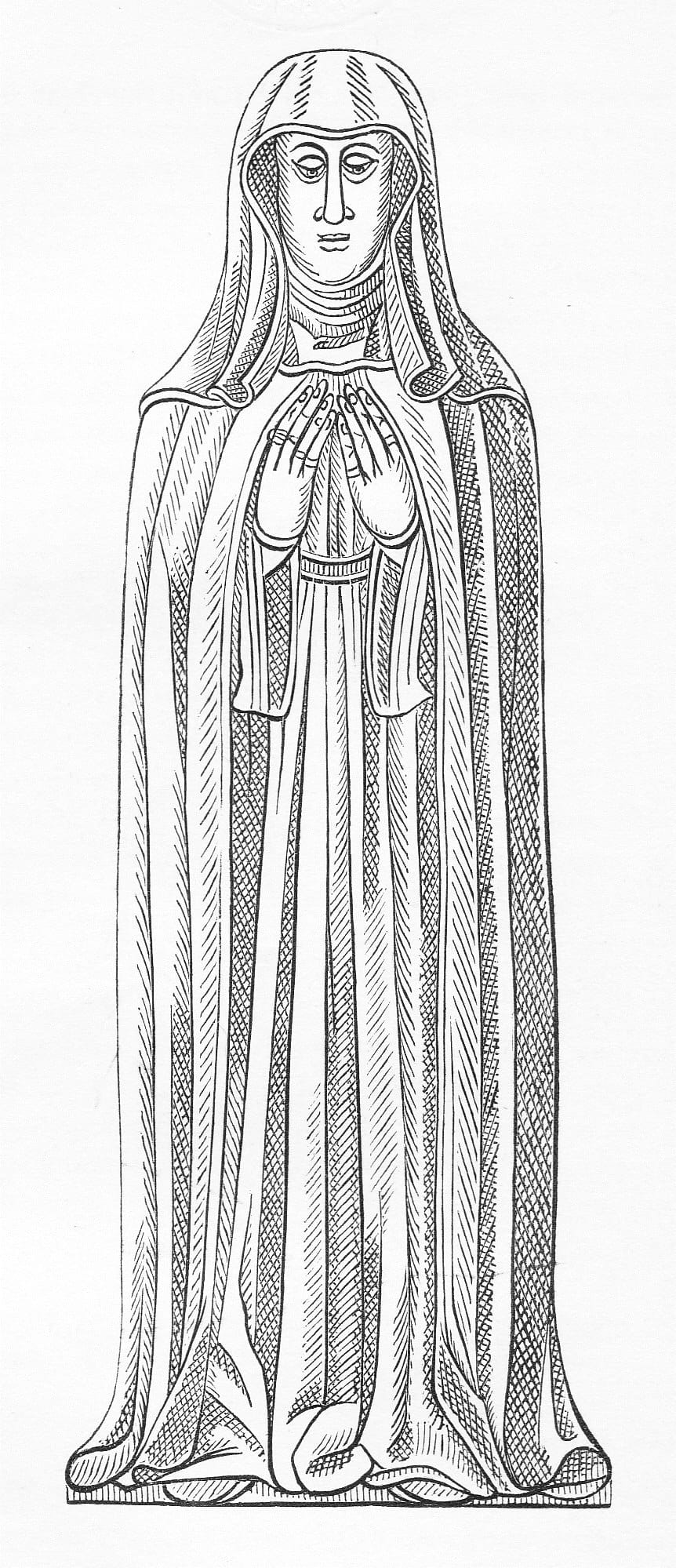
It is hard to know how the women of 1539 felt about these sudden, monumental changes. If any chronicled their experience of the events, it has been lost to the centuries. The economic impact, we’ve seen, was devastating. The psychological impact, we can only guess at. It's tempting with contemporary eyes to consider the Catholic convent a retrograde institution, especially under enclosure, which severely restricted nuns' contact with the rest of the community. But there was an opportunity for women to live in sorority, to build large organisations, to lead intellectual lives, and to contribute to the economy and the culture. Even women and girls outside the convents couldn’t have been indifferent to their only choice of a socially acceptable life outside marriage and motherhood suddenly disappearing.
Those with wealth, family and connections, had one fewer option. Others were left with none. As once wrote the 17th-century historian Thomas Fuller, who might have seen them as a child on the streets of London, “many a young nun proved an old beggar.”
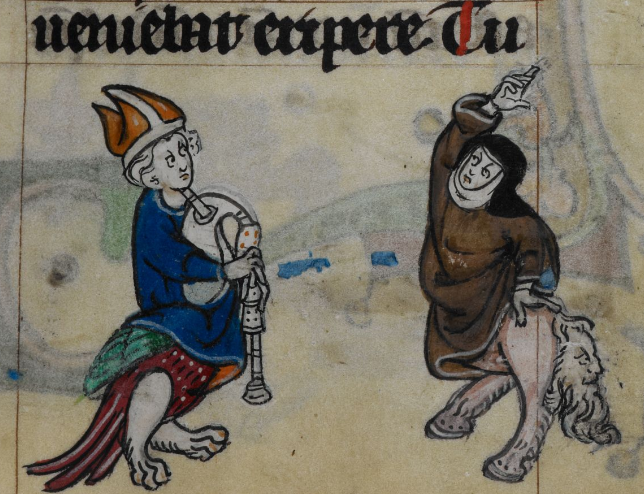
🎉 Easter egg for reading to the end! Support Broad History for the price of a 16th-century nun's paltry pension. Only below, get Broad History membership for just £2.67 a month the first three months.