“It's tragic for us that we don't know our own canon”
Fiona Sampson, poet, professor of literature and biographer of George Sand, Mary Shelley and Elizabeth Barrett Browning, talked to me on the podcast about rediscovering Sand and why women fall out of the literary canon. In case you missed it, have a listen to episode 2 of the podcast and make sure to subscribe (on Apple, Spotify, Youtube, etc...) so you never miss it again.
Vocational schools for the marriage mart
“We raise them like saints, then hand them over like fillies.” George Sand wrote this terrible sentence in a letter to her brother Hippolyte as his own daughter was about to marry. Prepare her, George begged. Tell her what she's in for. Her writing was explicit: “Nothing is so awful as the terror, the suffering and the disgust of a poor child who knows nothing and sees itself raped by a brute.”
George had reason to know that terror. She married at 18 the first man who paid her any attention. Her wedding had been mere months after the death of her grandmother, with whom she lived behind tall walls in a tiny village smack down in the middle of absolutely nowhere. Her only formal education had been in a convent school. Her world was as wide as what a horse might see between two blinders.
In that George Sand was typical of early 19th-century girls of the upper class. Their education, if you can call it that, served two purposes.
The first was to keep them from the world during the wilful adolescent years when they might stray and be “ruined”. Girls were typically tutored at home by their mother or a governess, but could also be sent in their teens to a finishing school where they might socialise with other daughters of the right kind of people . Their eloping from school was every parent's worst nightmare, and the better off could afford establishments that were serious about security. The walls around the English Augustinian school where George lived from the ages of 13 to 15 were two-story tall. Every window onto the street was barred and covered with an immoveable linen screen. Visitors were only admitted as far as the parlour; private lessons were held there too, with pupil and professor separated by a grate. The only hints of the outside world were the sounds of traffic that may carry over the walls or a glimpse of the street in the seconds between the gates' opening and closing. “Two whole years behind bars,” George wrote in her autobiography. “It was really a prison, but a prison with a large garden and plenty of company.” That's the catch. George never felt her cage. In the best cases, cloistered life offered sorority among women of all ages and a chance at (some) intellectual, emotional and spiritual development away from the dangers and distractions of mixed society. George was so taken in she had ambitions to become a nun.
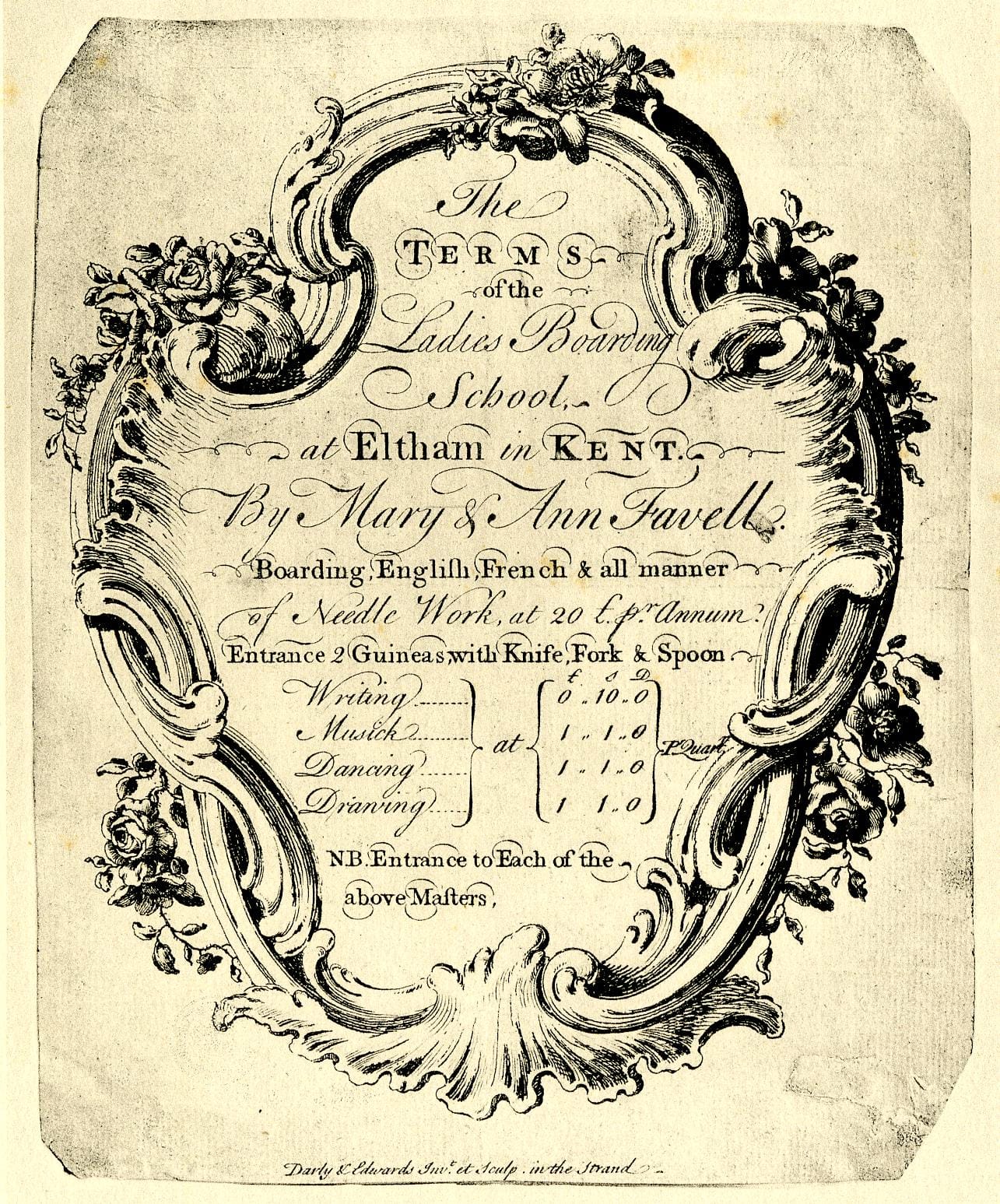
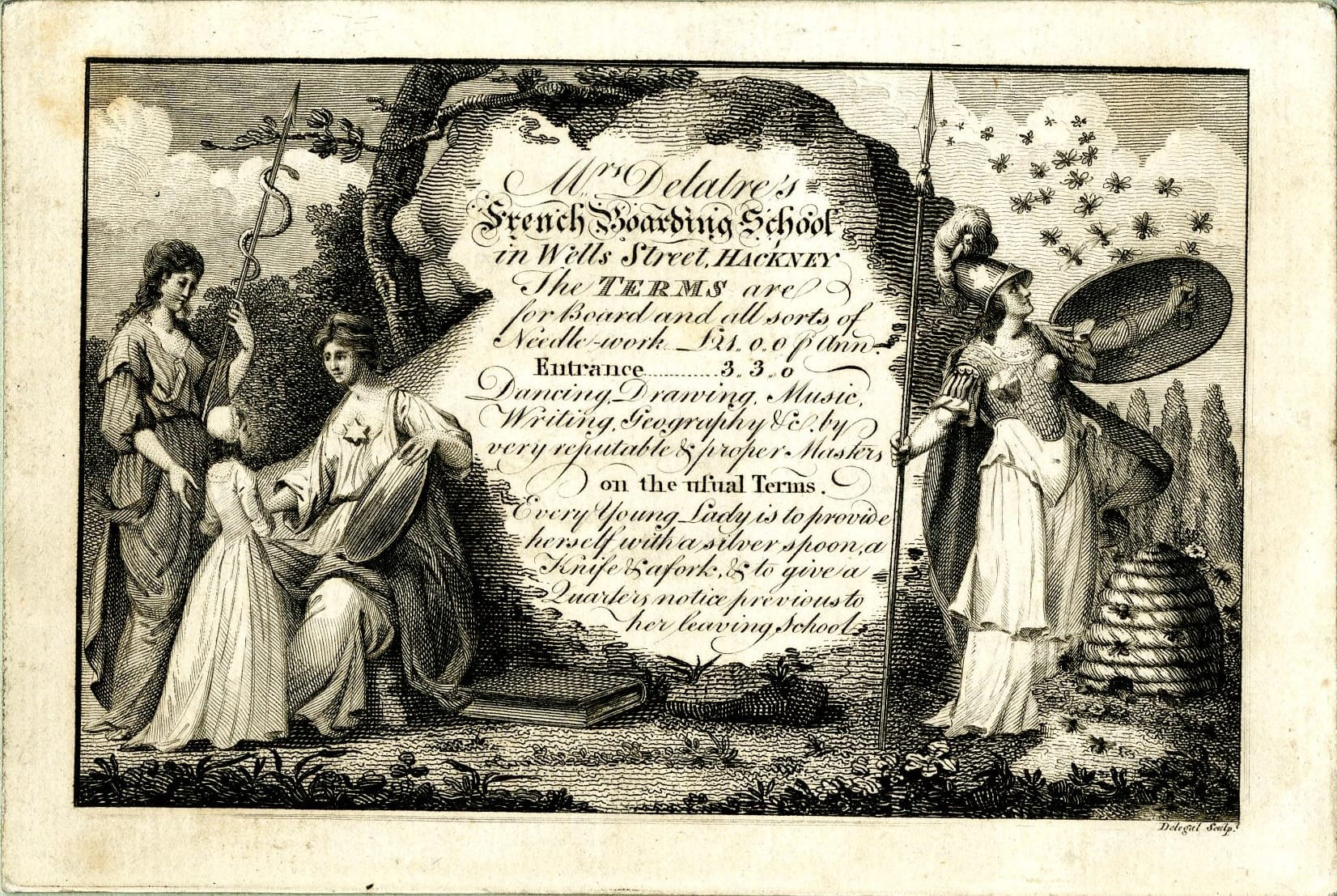
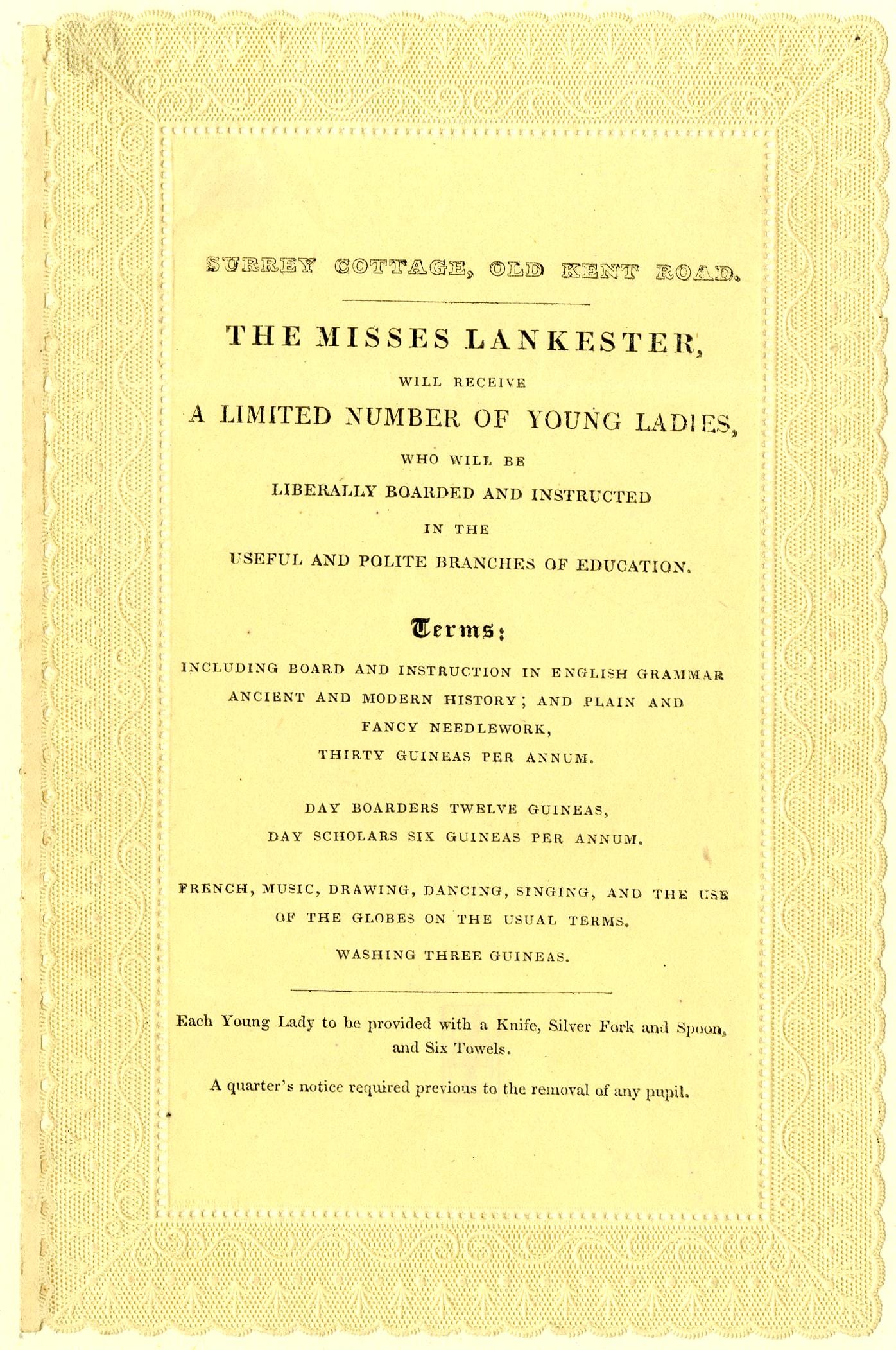
Trade cards for girls' boarding school in England, respectively from the mid-1750s, 1780 and 1800. Note that pupils were expected to enter schools with their own silverware and sometimes trousseau of sheets and towels, a not insignificant expense on top of tuition and board. © The Trustees of the British Museum. (CC BY-NC-SA 4.0)
But the cloister wasn't real life. Well-to-do families sent girls there for a second aim – to prepare them for marriage. They weren't so much armed for the realities of adulthood, as moulded into agreeable brides who might succeed on the marriage mart. Lessons focused on manners, modern languages and needlework. The better schools offered the rudiments of geography “with use of a globe” or history, and occasionally lessons in accounts so the future bride could manage a large household responsibly. Families paid extra fees to bring in dance, music or art masters. The subjects that prepared young minds to engage in politics and commerce – Latin and Greek, philosophy, literature, law, mathematics and the sciences – were reserved for gentlemen. What better way to keep young women subjugated than to deny them intellectual development?
The number of both boys' and girls' boarding schools exploded in the early 19th century as the rising middle classes sought to emulate the aristocracy and ensure their children's upward social mobility. That only made the quality of these establishments more haphazard. The system fed itself: it trained the middling teachers and governesses it would then inflict on the next generation. Ultimately, a girl's education was down to chance – having a father with a well-stocked library and a more liberal attitude could make all the difference.
You've seen this in pop culture. Bridgerton – not one where I expected historical accuracy to be honest, but on this it's correct – shows this well: the brothers are off to Eton and their Grand Tour, while the sisters stay home and learn to set a table. The mother tolerates one daughter's love of books and politics, but worries it will make her a spinster. Young brides' ignorance of sexuality or their own bodies is fodder for endless comedy. Because it's a historical romance produced in the 2020s, the female characters are eventually matched with kindly leading men who promise a marriage of equals. But you can see how it wouldn't work that way in the real world.
Isolation and lackluster education produced naïve young brides thrown into marriage like sacrificial lambs. Or breeding fillies. George Sand's relationship started in love – still a rare privilege in the 1820s – but her charming young husband turned out to have a drunken temper and profligate ways. He came to hate her, and she came to understand it. By her early 30s, she had separated; eventually sued for divorce; battled for custody of her two children, even when her ex attempted to kidnap them; wrestled back ownership of her childhood home, which the law had bestowed on her husband; and established herself as a best-selling author and mistress of her own destiny. She fell in love often after that, but came to see marriage as a tragedy because even love was doomed as long as one partner legally owned the other. Her novels were an indictment of it.
How, with such an unhelpful start in life, did George Sand and so many other intellectual women manage to rise and dominate the publishing industry in particular in the 19th century? That's for the next newsletter.
You've read to the end! Glad you enjoyed it and hope you learned something. If you value Broad History, please consider supporting it so I can keep making more. Thank you!