It started with a seemingly innocuous assumption, an easily made logical leap: For a rather long time, archeologists who found burial sites with weapons or hunting gear inside would label the remains as male.
It was, in the absence of other clues, an educated guess of sorts. Skeletons left in the ground for millennia were simply too damaged for forensic science to tell us much at first. Often there aren't even bones, only objects. To scientists living in a world where fighting and hunting were overwhelmingly male activities, it made sense. But as research technologies progress, we are learning how wrong we've been. Maybe our educated guesses were simply a failure of imagination.
In 2018 in the highlands of Peru, archeologists found the remains of a person they dubbed Wilamaya Patjxa individual 6. “WMP6” died around 9,000 years ago between the ages of 17 and 19 and was buried with a 24-piece big game hunting kit. An analysis of WMPG's femur and the peptides in her teeth determined her to be a woman. The researchers took this opportunity to review the remains of other Late Pleistocene and Early Holocene hunters found in the Americas. (Roughly, that's early modern humans until about 8,000 years ago.) Of the 27 skeletons of which the biological sex could be determined, 11 were women. The authors concluded with good statistical confidence that participation in Stone Age big game hunting was gender-neutral or near enough, more so than previously thought and more so than in contemporary societies. When you picture Stone Age hunters chasing wooly mammoths or vicuña, do you see 40% of them as women?
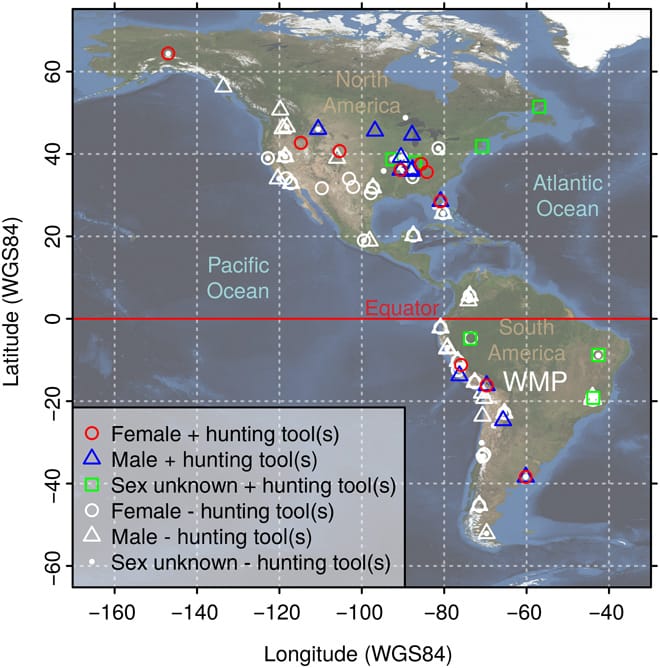
"Man the Hunter" and the limits on our imagination
The "Man the Hunter" myth took hold in the early 20th century on the back of a few fossil finds in Africa and posited that hunting was the seminal trait that took us from apes to modern humans. You heard it in school: standing tall freed men's hands for weapons and allowed them to peer over the top of tall grasses to spot preys and predators. That shifted the human body's centre of gravity, enabling the development of a larger cranium and therefore brain, moving us to the top of the food chain and to dominion over nature. All because we wanted meat. The theory assumed a strict gender specialisation in early human societies – prehistoric men hunting and warring, prehistoric women waiting at the cave with the children, gathering plants and preparing hides... It appealed to a definition of virility rooted in strength and violence, to a mental model of the nuclear family as "natural" and to gender roles shaped in the Victorian era. It was a lot of storytelling wrapped around a tiny bit of research.
It's with that model in mind that early archeologists and anthropologists labeled burial sites. They started questioning it as early as the 1960s though: it likely both overplayed the role of hunting in human societies and underplayed the role of women in it. Current research shows the division of labour wasn't nearly as neat before the introduction of agriculture. Women's physiological advantage for endurance could be an asset for stalking prey to exhaustion. Gathering likely provided most of the calories anyway, but where collective hunting was required, small communities could not do without half their able-bodied individuals. Communal childcare freed up young women for the hunt. Evolution gave human societies a rare gift – the menopause. It spared experienced women from the deadly gamble of childbirth and allowed them to transfer their knowledge to younger generations. It gave us grandmothers.
How sexist is anthropology anyway?
How much "Man the Hunter" endures and impacts current research is itself a matter of debate among anthropologists. They also disagree on how much women hunt in present-day hunter-gatherer societies and what that can tell us about our distant past. Don't look for consensus where the forward edges of research meet contemporary politics. If you want both sides, I found these two articles in The Conversation enlightening:
- Sarah Lacy and Cara Ocobock, who conducted the research on women's physiological advantage for the hunt, write that "the idea of 'Man the Hunter' runs deep within anthropology" and that they are often "accused of rewriting the past to fulfil a politically correct, woke agenda" despite bringing plenty of evidence as biological anthropologists.
- Vivek V. Venkataraman says "the theory died a well-deserved death decades ago" and is irrelevant. Of course, women were and are capable of hunting, but gender specialisation was and still is the norm, he argues.
My aim is not to replace an outdated theory, which imposed Victorian gender roles on prehistoric societies, with a different kind of anachronism, which would make out the Stone Age to be some kind of feminist utopia. I only aim to show how our own context can limit our understanding. If only men wield weapons, then all tombs with weapons are male. If only men are ever found interred with weapons, then it's unlikely women ever wielded them. We only see what we can imagine, and we only imagine some version of what we've seen. It takes a lot of unlearning to learn history.
Hope you're enjoying the read and learning something new. This simple article took hours of research in two books and half a dozen scientific journals. I'd appreciate your support to make more of this work possible. Hit the button below and then keep reading.
When assumptions become convictions
New research will continue to prove us wrong; that is the way of science. The 2,600-year-old mummy of a teenage Scythian warrior, found in Southern Siberia in 1988, was assumed male because it was found with a bow, a quiver of arrows and an axe. She was determined to be a girl in 2020. Old habits die hard: a Bronze age tomb (circa 1,900BC) found just last month in Normandy (sorry, link in French) is being presented all over the media as a male warlord's. The only clues are 27 decorative arrow heads and two knives.
Odds are the individual is a man. Before you can test the hypothesis, you need to make one. Fair enough. Problems arise when what should be a loosely held assumption becomes a politically charged conviction.
The "Birka warrior" is one of the most exceptional Viking tombs ever found. Excavated in 1878 in Birka, Sweden, tomb Bj 581 contained an adult skeleton, probably originally buried in a sitting position, with a sword, an axe, a spear, armour-piercing arrows, a battle knife, a full set of gaming pieces and, stunningly, two horses, a mare and a stallion laid at the individual's feet. This is the full kit of a professional warrior. The grave dominated the burial site and was marked by a large boulder visible from afar. Based on the grave goods and location, this 10th-century individual was understood to be a high-ranking officer with a mind for tactics and strategy and was labeled male. You know where this is going. A first osteological analysis in the 1970s determined the body to be female, but was quickly dismissed. The slender bones were again determined to be female in 2014, before a genome analysis confirmed it in 2017. The Birka warrior was a woman.
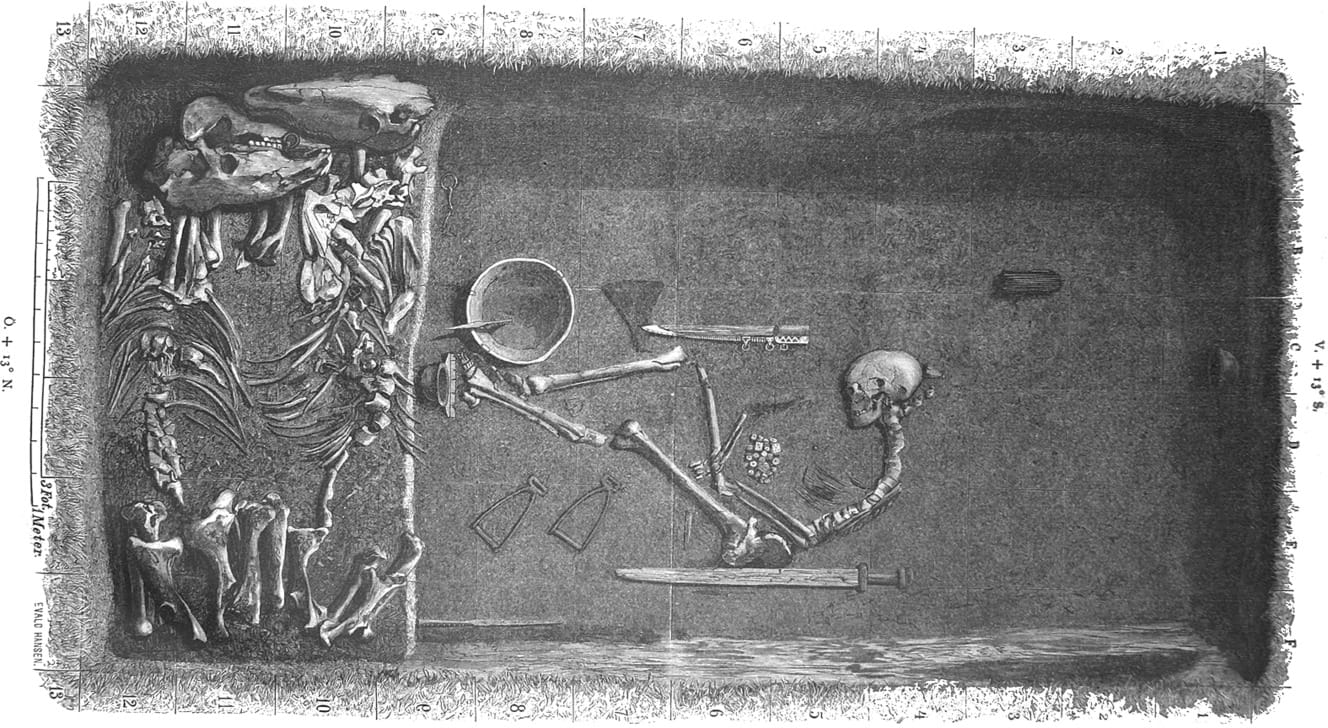
While some female Norse soldiers had been found before, she was the first high-status female warrior ever identified. Or was she? The second it was suggested Bj 581 was a woman, every conclusion made about her when she was thought a man was questioned. Maybe the grave goods were heirlooms or an homage to her family, not to her. Maybe there had been another, male body in the tomb, and it had been removed while hers and the horses' were left undisturbed. Maybe the 19th-century excavation had mislabeled samples. Maybe while biologically female, the individual had lived as a transgender man. Anything rather than imagine a woman may have led armies.
"The iron laws of the world that have existed since the beginning of time"
The study's authors were prudent and were taken aback by the criticism and online abuse (of course) they were subjected to. They did not write that soldiering was a gender-neutral activity in Norse society, only that the simplest explanation of the evidence before us is that Bj 581 was a woman and a high-status warrior, and that some women did manage to succeed in male-dominated fields. Fine, the authors added, be skeptical... but ask yourself why only now.
"Since [the site] was excavated in the 1870s, it has constantly been interpreted as a warrior grave because it looks like a warrior grave and it's placed by the garrison and by the hillfort. Nobody's ever contested it until the skeleton proved to be female, and then it was not a valid interpretation anymore."
- Charlotte Hedenstierna-Jonson, main author of the Bj 581 study
What we assume with ease when it comes to men's history, we concede with reluctance when it comes to women's. This would all be academic debate if certain forces in the world weren't wedded to a naturalistic and deterministic view of history, regardless of its scientific validity.
Stephen Miller, perhaps the most ideologically driven man in the Trump administration, told us: "We live in a world, in the real world... that is governed by strength, that is governed by force, that is governed by power. These are the iron laws of the world that have existed since the beginning of time." The emphasis is mine, on a part of the quote that is often omitted. In this world view, laws or values matter little. Change is neither desirable nor possible. Something universal and immutable in human nature commands. "It was always thus" is justification enough.
Any proof that it wasn't always thus, any scientific research that complicates the human story, is a challenge to their power. The idea that human flexibility – not human nature – rules is a threat. Whether prehistoric women hunted should be immaterial to the fate of 21st-century women. It isn't.
What did you think? Hit reply on the email to let me know or become a member to join the comments. Every Broad History article comes from hours of careful research. Consider becoming a paid subscriber to make this work possible.
In case you missed it
Episode 1 of the Broad History podcast touches on these findings and much more. Have a listen and make sure to subscribe (on Apple, Spotify, Youtube, etc...) so you never miss an episode.